
Dishwasher Buying Guide
History
1850: The First Patent – Joel Houghton patented a wooden machine that used a hand-turned wheel to splash water on dishes. It was slow and largely ineffective.
1886: The Modern Foundation – Josephine Cochrane, a wealthy socialite tired of her servants chipping her fine china, invented the first truly functional dishwasher. She famously said, “If nobody else is going to invent a dishwashing machine, I’ll do it myself.” Her design used water pressure and a wire rack to hold dishes still—the blueprint for modern machines.
1893: World’s Fair Debut – Cochrane’s machine won the top prize for mechanical construction at the World’s Columbian Exposition in Chicago. Her company eventually became KitchenAid.
1924: The First Integrated Machine – William Howard Livens invented a small dishwasher suitable for home use, featuring the first front-loading door and a rotating sprayer arm.
1940: Electric Drying – As indoor plumbing and electricity became standard, dishwashers began incorporating electric drying elements.
1950s: Post-War Boom – The economic surge made the dishwasher a coveted status symbol. Designs became more compact and standardized for suburban kitchens.
1970s: Aesthetic Integration – Dishwashers became common in middle-class homes and began to “blend in”. Manufacturers introducedunder-the-counter models and panels that matched kitchen cabinetry.
1980s: Protection & Precision – Innovations shifted toward reliability and efficiency. Aquastop technology was introduced in 1985 to prevent water damage by automatically shutting off the water flow if a leak was detected.
1990s: The Smart Sensor Era – This decade saw the introduction of soil sensors (or turbidity sensors). These computerized tools measure food particles in the water to automatically adjust the wash time and water usage based on how dirty the dishes actually are.
2000s: Energy Star & Ultra-Quiet Operation – Global energy standards led to the development ofEnergy Star-rated models, which significantly reduced electricity and water consumption. Advanced insulation and brushless motors were also introduced to make machines virtually silent.
2010s: Connectivity & Convenience – Wi-Fi connectivity became a standard feature in high-end models, allowing users to start cycles or monitor salt and rinse-aid levels remotely via smartphone apps. Third racks (or cutlery drawers) also became popular, freeing up space in the main baskets.
2020s & Beyond: AI and Eco-Optimization – Modern machines now utilize AI to learn user habits and advancedeco-friendly drying systems, such as zeolites or automatic door-opening, to dry dishes without high-heat energy consumption.
How Dishwashers Work
Dishwashers clean dishes by recycling pressurized hot water mixed with detergent. First, a basin at the bottom fills with water, which internal elements heat up. An electric pump forces this hot liquid through spinning spray arms, blasting food debris off your dishes. The dirty water drains through a filter, and the machine refills with clean water for rinse cycles. Finally, the dishwasher dries the dishes using an exposed heating element to bake the air, or condensation drying, where the hot moisture naturally clings to the cooler stainless steel walls.
There are really only 3 levels of dishwashers- builder’s grade, mid level, and premium. The areas in between tend to be related to marketing.
| Grade | Description | Avg Cost |
|---|---|---|
| Builder’s Grade | This will get the job done, but really you’re the dishwasher and it’s a sanitizer. Builder’s grade dishwashers tend to stop working sooner than other models because they have plastic tubs and parts. | $450 |
| Mid-Level | Once you get up to mid-level, you start having stainless steel tubs that last longer, as well as useful features like a third rack and hard food disposer. | $800 |
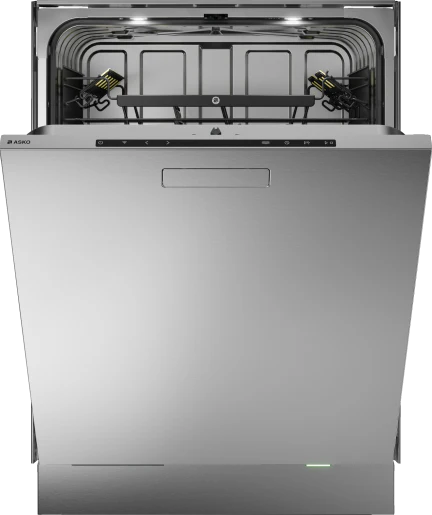
| Premium | The top level brands like Asko, Miele, Bertzzoni, Bosch Benchmark, etc. These have tankless water heaters rather than a bake element, so they heat the water much hotter than the other two grade levels. They usually only need to be run on Auto and are quieter and stronger than builder’s grade or premium. | $1,350 |
| Grade | Features | Tub/Noise |
|---|---|---|
| Builder Grade | Front plastic controls, Fixed racks, Exposed heating element | Plastic tub / 52-60 dBA |
| Mid-Level | Hidden top controls, Adjustable third rack, Condensation drying | Stainless steel tub / 44-48 dBA |
| Premium | Capacitive touch, Flexible spray racks, Zeolite mineral drying | Premium stainless tub / Under 42 dBA |