
Range Buying Guide
History
Ancient Times – 1700s: The Open Hearth – For millennia, cooking happened over open fires or in brick hearths. It was dangerous, smoky, and required constant tending of wood or charcoal.
1740s: The Franklin Stove – Benjamin Franklin invented the “Pennsylvania Fireplace,” an iron-lined furnace that provided more heat and less smoke than an open hearth, though it was primarily for heating.
1790s: The Rumford Range – Sir Benjamin Thompson (Count Rumford) designed a large cylindrical stove with adjustable heat levels for individual pots, the first true precursor to the modern range top.
1830s: Cast Iron Coal Stoves – As coal became a popular fuel, cast iron stoves like the Jordan Mott design became common. These allowed for multiple cooking surfaces and an enclosed oven for baking.
1850s: The Gas Revolution – James Sharp patented the first commercially successful gas stove. While cleaner than coal, gas ranges didn’t take off until gas lines became a standard utility in cities toward the end of the century.
1890s: The Electric Range – Thomas Ahearn demonstrated the first electric oven in Canada, but it was inefficient. It wasn’t until 1906 that David Curle Smith patented a practical electric stove with heating elements.
1920s: Thermostats and Enamel – Integrated thermostats allowed for precise temperature control, and the introduction of white porcelain enamel made stoves much easier to clean, transforming them into stylish kitchen centerpieces.
1940s – 1950s: The Post-War Kitchen – The “standard” range emerged, featuring a four-burner top and a large oven below. Features like timers and clock displays became common.
1970s: The Glass Revolution – The introduction of ceramic glass cooktops changed kitchen aesthetics. These “smooth-tops” replaced exposed electric coils with a flat surface that was easier to clean and provided a modern, streamlined look.
1980s: Convection Goes Mainstream – High-end ranges began incorporating convection fans. By circulating hot air throughout the oven cavity, these ranges eliminated cold spots and allowed for faster, more even baking and roasting.
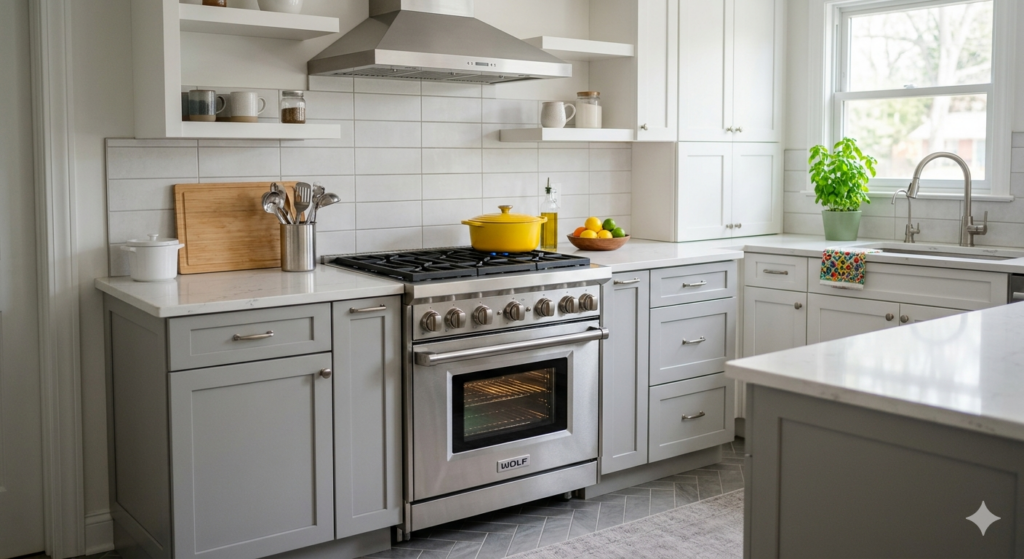
1990s: Professional Ranges for the Home – High-BTU, “pro-style” ranges (like those from Viking and Wolf) became massive status symbols. Homeowners began installing heavy-duty stainless steel ranges that mimicked commercial kitchens, featuring powerful burners and oversized knobs.
2000s: Induction Gains Traction – While the technology existed earlier, induction cooking became more affordable and popular. By using electromagnetic fields to heat the cookware directly rather than the glass surface, it offered boiling speeds twice as fast as traditional electric or gas.
2010s: Dual-Fuel and Air Fry – The dual-fuel range (gas burners for the stovetop and electric for the oven) became the “gold standard” for serious cooks. This decade also saw the integration of Air Fry modes, using high-speed convection to mimic deep-frying without the oil.
2020s: The Smart & Eco Era – Modern ranges now feature Wi-Fi and AI integration, allowing users to preheat ovens via smartphone or use internal cameras to monitor a turkey’s progress. Additionally, there is a major shift toward electric and induction as many regions phase out gas hookups for environmental reasons.
A range includes a cooktop and an oven. The oven is just the opening you bake in. A stove is a catchall term from back when you used the same stove to cook and heat a home.
Types of Ranges
| Type | Look | Description |
|---|---|---|
| Freestanding | Finished sides and a rear control backguard | Most common and affordable option that stands alone or fits between cabinets. |
| Slide-In | Front-mounted controls and no rear backguard | Sits flush with countertops for a sleek built-in look that highlights your backsplash. |
| Drop-In | Rests directly on a cabinet base support. These are no longer common | Offers a completely integrated custom cabinetry appearance. |
Types of Fuels
| Type | Description |
|---|---|
| Natural Gas | Instant flame control; fast cooktop heating; slower oven preheat times. |
| Liquid Propane | High heat output; requires tank refills; slower oven preheat times. |
| Electricity | Steady simmering; smooth cleanup; fast oven preheating; holds residual heat. |
| Dual Fuel | Precise gas cooktop control combined with fast electric oven preheating. |
| Induction | Fastest cooktop boiling; precise temperature response; requires magnetic cookware; safe cool-touch surface. |
Average Prices of Ranges
| Type | Description | Avg Price |
|---|---|---|
| Gas Budget | Basic mechanical knob controls; manual clean oven; standard low-BTU burners | $650 |
| Gas Mid-Level | Convection baking; integrated air fry modes; high-output power burners; self-cleaning | $1,450 |
| Gas Affordable Luxury | Heavy-duty brass burners; continuous cast-iron grates; dual-fuel configurations; smart Wi-Fi | $3,100 |
| Electric Budget | Exposed coil or basic radiant glass cooktop; standard bake and broil; manual clean | $550 |
| Electric Mid-Level | True convection fan; expandable dual/triple cooktop elements; hidden bake element; self-cleaning | $1,150 |
| Electric Affordable Luxury | Touchscreen control panels; air sous vide; fast multi-rack baking; premium finishes | $2,500 |
| Induction Budget | Entry-level glass induction surface; digital touch-activated burner controls; standard oven cavity | $1,100 |
| Induction Mid-Level | Auto-sizing magnetic elements; total convection baking; rapid-boil settings; self-cleaning | $1,900 |
| Induction Affordable Luxury | Bridge-linked cooking zones; precision temperature probes; guided recipe apps; steam assist | $3,600 |
Features
Entry Level Features
| Feature | Description |
|---|---|
| All-Mechanical Controls | Manual knobs and basic digital timers without complex touchscreens. |
| Standard Burner Output | Burners top out between 12000 and 14000 BTUs with less precise simmer controls. |
| Individual Wire Grates | Lightweight porcelain-coated steel or thin iron grates sitting over single burners. |
| Standard Thermal Baking | Relies on a single bottom gas burner tube without any circulating fans. |
| Drop-Down Broiler Drawer | Separate broiler compartment located below the main oven cavity instead of inside it. |
Middle Class Features
| Feature | Description |
|---|---|
| All-Mechanical Controls | Manual knobs and basic digital timers without complex touchscreens. |
| Standard Burner Output | Burners top out between 12000 and 14000 BTUs with less precise simmer controls. |
| Individual Wire Grates | Lightweight porcelain-coated steel or thin iron grates sitting over single burners. |
| Standard Thermal Baking | Relies on a single bottom gas burner tube without any circulating fans. |
| Drop-Down Broiler Drawer | Separate broiler compartment located below the main oven cavity instead of inside it. |
Affordable Luxury Features
| Feature | Description |
|---|---|
| Commercial Pro Aesthetics | Heavy-gauge stainless steel build with thick metal knobs and pro handles. |
| Custom Finishes | Interchangeable hardware colors like brushed bronze or custom porcelain doors. |
| Dual-Stacked Burners | Burners delivering up to 22000 BTUs that shrink to a 750 BTU simmer flame. |
| Chromium Griddles | Built-in heavy cooktop griddles coated in scratch-resistant chrome material. |
| Guided Cooking Centers | Full-color digital touchscreens displaying recipes and step-by-step imagery. |
| Ball-Bearing Glide Racks | Heavy-duty oven racks moving smoothly on bearings to support large roasts. |
| Soft-Close Doors | Hydraulic dampers inside the door hinges that prevent heavy doors from slamming. |
| Air Sous Vide | Specialized low-temperature fan programs for precision slow cooking. |