
Kitchen Ventilation
When you use a cooktop, whether standalone or on top of a range, you release monsters into the air. Grease, moisture, and smoke are bad guys who want to hurt your health and home.
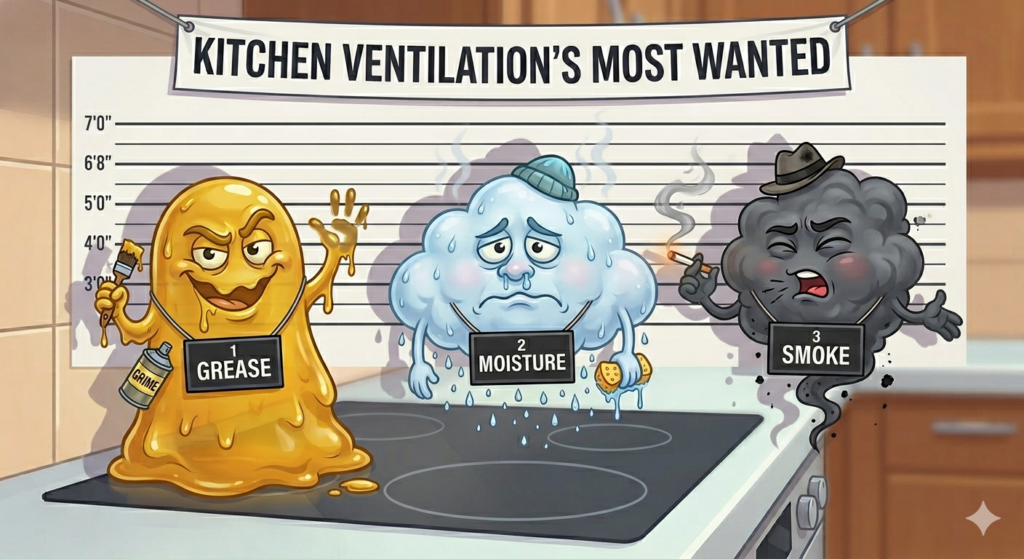
These three nogooders are fought by three types of ventilation systems. Let’s meet the first two:
Ductless Range Hood vs Downdraft Vent: The Truth About Kitchen Smoke
The truth is, both of two systems can fight these three monsters…but they only capture what they can physically touch.
Master of Recirculation: Ductless Range Hoods
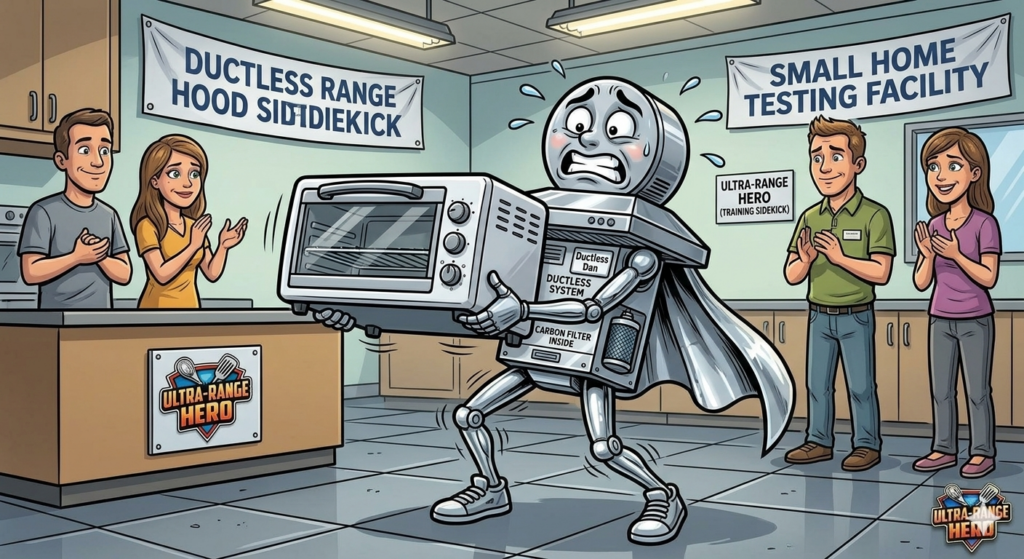
Ductless range hoods pull in smoke and grease, trapping them in charcoal filters before pushing the scrubbed air right back into your kitchen.
The Moisture Failure
Charcoal filters cannot trap moisture. The hood releases hot air back into the atmosphere. This means the kitchen will be hotter and more humid, plus the odors will be stronger and longer lasting, than with a ducted system.
Note- A ductless range hood should only be used with electric or induction cooktops only. It works with a gas range but isn’t a good idea.
The Downdraft Compromise: Form Over Function
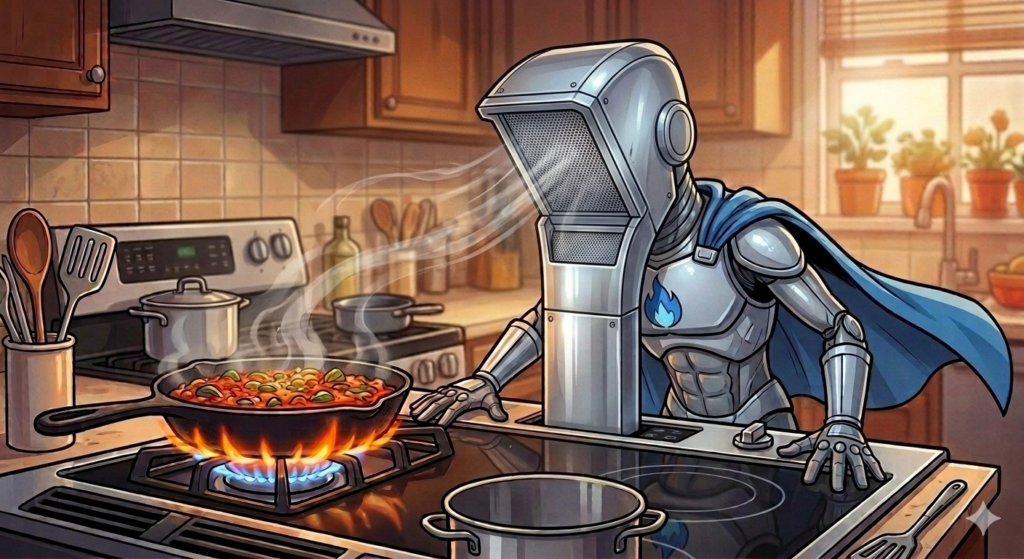
Downdraft systems pull smoke, steam, and grease downward through a slot in the cooking surface to keep your room views completely open.
In terms of ventilation, downdrafts can be either recirculating or ducted. A recirculating unit, whether pop up or built in, is like an upside down version of the ductless range hood we just discussed above. A ducted unit is for houses with basements or crawl spaces that can run pipes underneath the subflooring to the outside.
A recirculating unit is similar to a ductless hood in another way- it doesn’t capture moisture. A ducted unit can dispel a certain amount of moisture, but it still has one huge problem…
The Physics Failure (Gravity Wins)
Forcing hot air and steam downward fights basic physics. Because it lacks an overhead canopy to capture expanding plumes, even a ducted downdraft vent struggles to pull in emissions from tall pots or heavier smoke.
Because downdraft vents are usually located next to a burner, they tend to pull open gas flames, resulting in uneven heating or accidentally extinguishing simmering burners. Like ductless range hoods, it’s recommended to only use downdraft vents with electric or induction cooktops.
A New Monster Emerges
While those two vents fight visible grease and smoke, an invisible, odorless villain also enters the arena. It appears only with natural gas and propane cooktops. Recirculating filters cannot touch it. Meet the ultimate killer: Toxic Combustion Gases (rendered as visible for our purposes):
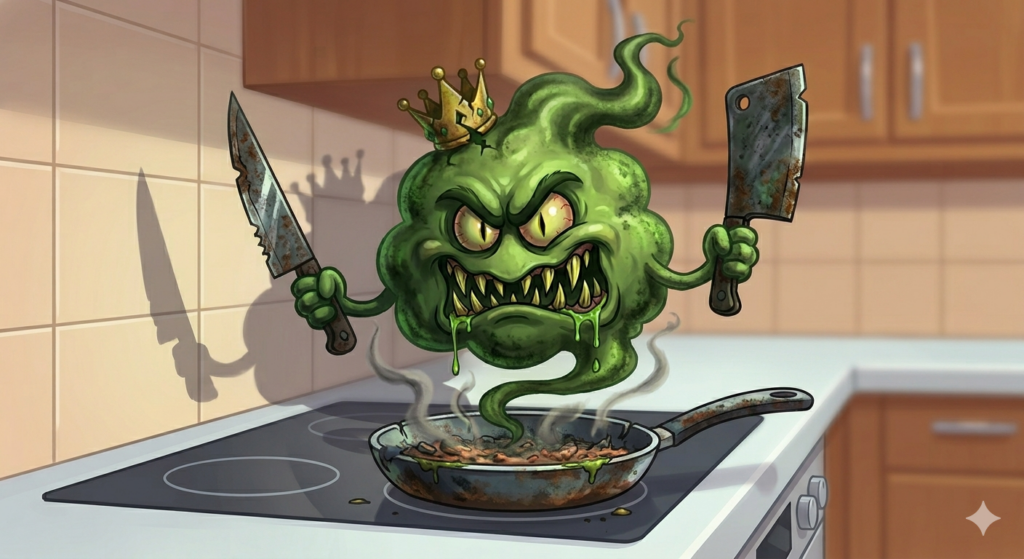
Heating up your stove unleashes toxic gases like Nitrogen Dioxide, Carbon Monoxide, and Benzene. These chemical hazards easily bypass recirculating filters and countertop vents, directly targeting your lungs and bloodstream.
Luckily, there is a hero among us whose only job is to rid the world of these pesky monsters, while also still combating its sidekicks grease, moisture, and smoke…
The Ultimate Defense: Ducted Range Hoods

An overhead ducted range hood is the only system that completely clears the kitchen by physically capturing and banishing all the monsters outside.
Ducted range hoods work with either electric, induction, or gas ranges/cooktops. You just have to get one that’s the right size and CFM power!
What Size Range Hood Do I Need? A Quick Guide

Finding the correct size for your range hood comes down to two things- width and power, which is measured in cubic feet per minute (CFM).
What Width Should My Range Hood Be?
Your range hood should be at least as wide as your range or cooktop. Ideally, it’ll be 3 inches wider on each side, or 6 inches total.
How many CFM (Cubic Feet per Minute) do I need?
For an induction or electric cooktop, multiply the width (in inches) by 10. Ex- a 30 inch cooktop needs 300 CFM.
Electric and induction cooktops are simple. You don’t have to go farther than this. Exception- Do you happen to be looking into what to do with an island cooktop? If so, multiply by 15 due to pesky crosswinds.
For a gas cooktop, divide the total maximum BTU’s by 100. If a four burner range has 50,000 total BTU’s when it’s burners are maxed out, it needs a range hood capable of handling 500 CFM.
What About Larger Ranges and Cooktops?
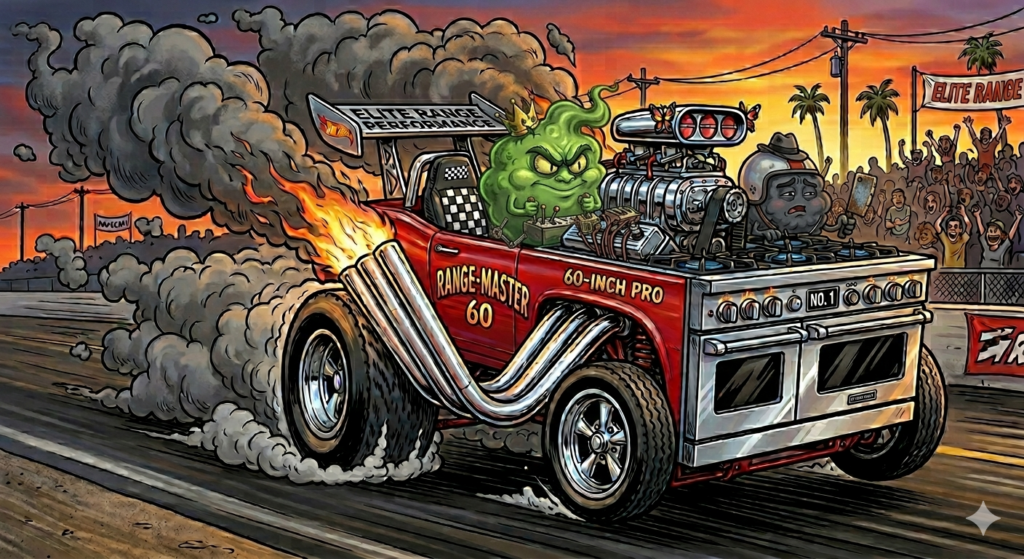
In terms of width and CFM, larger ranges aren’t any different. You still want a hood that’s 3 inches larger on each side than the range or cooktop it’s above, or 6 total.
For an electric or induction cooktop, the largest size cooktop is 60″, so the largest range hood you’ll ever need is 66″ wide and 600 CFM.

For a gas cooktop, you still just divide the maximum number of BTU’s by 100. The highest number of BTU’s on the market is the Bluestar 60 Series Platinum Range with 8 burners putting out 174,000 BTU’s!
Divided by 100, that means it needs 1740 CFM of ventilation power. That’s a lot of make up air!
What Are Make Up Air Systems?
When putting in a large system, there are other air pressure considerations. One is a make up air system. Building codes dictate that any range hood taking in over 400 cubic feet per minute must have an equivalent amount of make up air.
A make up air system is a mechanical damper that opens whenever the cooktop is turned on, allowing fresh air to enter the house and offset the decompression caused by the hood.
Other Considerations
A ducted range hood for a cooktop as big as the Bluestar must be connected to 10 or more inch rigid metal duct run straight out of the house. It shouldn’t be choked down below 10 at any point.
The back wall behind a range that big must be non-combustible.
Having a make up air system as large as the one described would need climate control as well, either through heating or dehumidifying.
The matching hood for the Bluestar weighs 115lbs. If the motor is directly inside the hood, it is over 150lbs. This will require careful mounting.
Because this type of suction requires so much machinery, the noise generated usually means it’s best to have an inline or remote blower. The good news is that this will make it as quiet as a mouse.
In the end, the best way to figure out ventilation is contact your ol’ pal Uncle Scott at Neu Appliances first. Call 512-992-2714 or or Email!